Top tracks
Listeners also bought
Other World Fusion albums
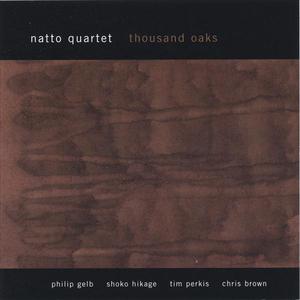
Put your hands on the remote! browse music »Thousand Oaks by Natto Quartet
view larger image
fave it World Fusion
7 tracks | 43 minutes
Released May 2005
on 482 Music
Click
for a 30-second preview. All tracks are 192kbps high fidelity sound quality. Protected WMA $0.77 or unprotected MP3 $0.88.
listen album 30sec. shuffle buy CD review album promote album
- sample lyrics "DOWNLOAD" 11:06 Ume lyrics BUY MP3 11:06 Ume lyrics "GIFT MP3" 11:06 Ume
- sample lyrics "DOWNLOAD" 08:43 Dengaku lyrics BUY MP3 08:43 Dengaku lyrics "GIFT MP3" 08:43 Dengaku
- sample lyrics "DOWNLOAD" 04:48 Kinpira lyrics BUY MP3 04:48 Kinpira lyrics "GIFT MP3" 04:48 Kinpira
- sample lyrics "DOWNLOAD" 03:20 Genmaicha lyrics BUY MP3 03:20 Genmaicha lyrics "GIFT MP3" 03:20 Genmaicha
- sample lyrics "DOWNLOAD" 04:24 Kuri-ae lyrics BUY MP3 04:24 Kuri-ae lyrics "GIFT MP3" 04:24 Kuri-ae
- sample lyrics "DOWNLOAD" 06:43 Chawan mushi lyrics BUY MP3 06:43 Chawan mushi lyrics "GIFT MP3" 06:43 Chawan mushi
- sample lyrics "DOWNLOAD" 04:36 Shochu lyrics BUY MP3 04:36 Shochu lyrics "GIFT MP3" 04:36 Shochu
Thousand Oaks further documents the Natto Quartet's singular approach to finding common ground for collective improvisation with instruments from otherwise disparate eras, cultures and musical genres
Editorial review
Released two years after Headlands, the group's debut, Thousand Oaks brings proof that Natto Quartet might be in it for the long run, and most certainly has the strength to do so. "East meets West" is not a new concept in music, not even in free improvisation. What sets this album apart, though, is that there is no "East meets West" going on here -- in fact, there is no "East" or "West" at all. Chris Brown's disembodied piano notes and Tim Perkis' subversive electronics sound as exotic or outside of one's own culture as Philip Gelb's shakuhachi and Shoko Hikage's koto. And it seems likely that Japanese listeners would feel the same way. After all, no one in this group plays his or her instrument in a conventional way. Hikage's bowing techniques in "Chawan Mushi" make the koto sound like a Chinese erhu. Gelb bends notes on the bamboo flute in ways that should be impossible. Brown's playing may be the most conventional on this album, as he doesn't use preparations or play directly on the strings a lot, but he engages the koto in complex dialogues and uses an unsettling form of fractured phrasing. Perkis' computer doesn't add a modern touch to the sound palette as much as it expands it from the inside. The album consists of seven tracks recorded in the studio. "Ume" is the longest one at 11 minutes, and is given the task of setting the mood. It is not the group's best effort, but it puts the listener in a receptive frame of mind. The other improvisations are all shorter (between three and nine minutes) and exquisitely started and stopped. "Kinpira" and "Kuri-ae" stand out, mostly because of the range of emotions they set in motion, but each track features a very strong level of ensemble playing. Thousand Oaks is the album of a group that is in complete possession of its art but still holds a few surprises for the future. Come for the unorthodox instrumentation, stay for the level of collective improvisation. ~ Fran?ois Couture, All Music Guide
Bio / Background
Critics called Natto Quartet's April 2003 debut, Headlands, "exotic, equisitely crafted, and eye opening" (Signal to Noise) and "music for our time" (AllAboutJazz.com), with The Wire's Bill Shoemaker noting, "each sound has the self-contained integrity of a stroke of masterful calligraphy." "The sound is so arresting and unique," mused WEMU Music Librarian/Cadence Senior Columnist Michael G. Nastos, "that the open-minded listener cannot help but be completely drawn into their weave of sonic wonder. It's a truly new music unlike anything I've ever heard, a strong candidate for best avant project of 2003, and sure to turn many a global thinking, progressive-minded ear inside out." Thousand Oaks further documents the group's singular approach to finding common ground for collective improvisation with instruments from otherwise disparate eras, cultures and musical genres.