Top tracks
- Sahak Dzoraporetsi (7th c.) With the All-Conquering Banner
- Nerses Lambronatsi (13th c.) Heaven's Armies Triumph
Listeners also bought
Other Choral Music albums
Other Early Music albums
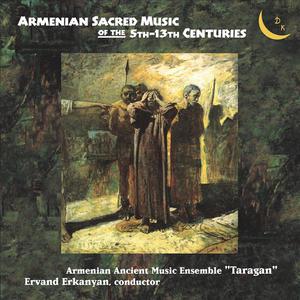
Put your hands on the remote! browse music »Armenian Sacred Music Of The 5th-13th Centuries by Armenian Ancient Music Ensemble "taragan". Ervand Erkanyan, Artistic Director
view larger image
fave it Choral Music | Early Music
18 tracks | 65 minutes
Released Jul 2007
on CDK Music
Click
for a 30-second preview. All tracks are 192kbps high fidelity sound quality. Protected WMA $0.77 or unprotected MP3 $0.88.
listen album 30sec. shuffle buy CD review album promote album
- sample "DOWNLOAD" 03:15 Mesrop Mashtots (5th c.) Great is Thy Charity BUY MP3 03:15 Mesrop Mashtots (5th c.) Great is Thy Charity "GIFT MP3" 03:15 Mesrop Mashtots (5th c.) Great is Thy Charity
- sample "DOWNLOAD" 03:43 Stepanos Syunetsi (5th c.) Pharaoh with His Chariots BUY MP3 03:43 Stepanos Syunetsi (5th c.) Pharaoh with His Chariots "GIFT MP3" 03:43 Stepanos Syunetsi (5th c.) Pharaoh with His Chariots
- sample "DOWNLOAD" 03:05 Sahak Partev (5th c.) Thee, Who Saved Three Adolescents BUY MP3 03:05 Sahak Partev (5th c.) Thee, Who Saved Three Adolescents "GIFT MP3" 03:05 Sahak Partev (5th c.) Thee, Who Saved Three Adolescents
- sample "DOWNLOAD" 03:07 Movses Khorenatsi (5th c.) Wonder of Birth BUY MP3 03:07 Movses Khorenatsi (5th c.) Wonder of Birth "GIFT MP3" 03:07 Movses Khorenatsi (5th c.) Wonder of Birth
- sample "DOWNLOAD" 04:12 Ananiya Shirakatsi (6th c.) Dove, Granted from Heavens BUY MP3 04:12 Ananiya Shirakatsi (6th c.) Dove, Granted from Heavens "GIFT MP3" 04:12 Ananiya Shirakatsi (6th c.) Dove, Granted from Heavens
- sample "DOWNLOAD" 03:40 Sahak Dzoraporetsi (7th c.) With the All-Conquering Banner BUY MP3 03:40 Sahak Dzoraporetsi (7th c.) With the All-Conquering Banner "GIFT MP3" 03:40 Sahak Dzoraporetsi (7th c.) With the All-Conquering Banner
- sample "DOWNLOAD" 04:57 Komitas Akhtsetsi (7th c.) Devoted Souls BUY MP3 04:57 Komitas Akhtsetsi (7th c.) Devoted Souls "GIFT MP3" 04:57 Komitas Akhtsetsi (7th c.) Devoted Souls
- sample "DOWNLOAD" 06:10 Grigor Narekatsi (10th c.) Eyes Like Sea BUY MP3 06:10 Grigor Narekatsi (10th c.) Eyes Like Sea "GIFT MP3" 06:10 Grigor Narekatsi (10th c.) Eyes Like Sea
- sample "DOWNLOAD" 04:06 Nerses Shnorali (12th c.) New Flower BUY MP3 04:06 Nerses Shnorali (12th c.) New Flower "GIFT MP3" 04:06 Nerses Shnorali (12th c.) New Flower
- sample "DOWNLOAD" 02:58 N. Shnorali (12th c.) Creator of Adolescents BUY MP3 02:58 N. Shnorali (12th c.) Creator of Adolescents "GIFT MP3" 02:58 N. Shnorali (12th c.) Creator of Adolescents
- sample "DOWNLOAD" 03:22 N. Shnorali (12th c.) Let Us Recollect God’s Name in the Night BUY MP3 03:22 N. Shnorali (12th c.) Let Us Recollect God’s Name in the Night "GIFT MP3" 03:22 N. Shnorali (12th c.) Let Us Recollect God’s Name in the Night
- sample "DOWNLOAD" 03:47 N. Shnorali (12th c.) Christ Reaching out his Hands BUY MP3 03:47 N. Shnorali (12th c.) Christ Reaching out his Hands "GIFT MP3" 03:47 N. Shnorali (12th c.) Christ Reaching out his Hands
- sample "DOWNLOAD" 03:11 N. Shnorali (12th c.) Bright Morning BUY MP3 03:11 N. Shnorali (12th c.) Bright Morning "GIFT MP3" 03:11 N. Shnorali (12th c.) Bright Morning
- sample "DOWNLOAD" 02:07 N. Shnorali (12th c.) Confessed with the Seraphs. Song of the De BUY MP3 02:07 N. Shnorali (12th c.) Confessed with the Seraphs. Song of the De "GIFT MP3" 02:07 N. Shnorali (12th c.) Confessed with the Seraphs. Song of the De
- sample "DOWNLOAD" 05:02 N. Shnorali (12th c.) Human Race Rejoice. Song of Resurrection BUY MP3 05:02 N. Shnorali (12th c.) Human Race Rejoice. Song of Resurrection "GIFT MP3" 05:02 N. Shnorali (12th c.) Human Race Rejoice. Song of Resurrection
- sample "DOWNLOAD" 03:45 Vardan Areveltsi (13th c.) You, Who Adorned Yourselves BUY MP3 03:45 Vardan Areveltsi (13th c.) You, Who Adorned Yourselves "GIFT MP3" 03:45 Vardan Areveltsi (13th c.) You, Who Adorned Yourselves
- sample "DOWNLOAD" 02:14 Nerses Lambronatsi (13th c.) Christ is Risen BUY MP3 02:14 Nerses Lambronatsi (13th c.) Christ is Risen "GIFT MP3" 02:14 Nerses Lambronatsi (13th c.) Christ is Risen
- sample "DOWNLOAD" 02:40 Nerses Lambronatsi (13th c.) Heaven's Armies Triumph BUY MP3 02:40 Nerses Lambronatsi (13th c.) Heaven's Armies Triumph "GIFT MP3" 02:40 Nerses Lambronatsi (13th c.) Heaven's Armies Triumph
Early choral Armenian sacred music
Bio / Background
"But God remembered Noah and all the wild animals and the livestock that were with him in the ark, and He sent a wind over the earth and the waters receded. Now the springs of the deep and the floodgates of the heavens had been closed, and the rain had stopped falling from the sky. The water receded steadily from the earth. At the end of the hundred and fifty days the water had gone down, and on the seventeenth day of the seventh month the ark came to rest on the mountains of Ararat."
(GENESIS 8:1-5)
After his descent from Ararat, Noah first stepped on the land which over centuries became the first Christian country. Christianity has been the Armenian state religion since 301 AD, 79 years before it became the official state religion of the Roman Empire.
The history of Christianity in Armenia refers to the time when Apostles St. Thaddeus and Bartholomew preached in Armenia around 100 AD.
↓ more ↓According to the legend, at the end of the 3rd century King Trdat III began persecuting Christians in Armenia. He executed a group of thirty-seven Christian virgins who had fled to Armenia to escape Roman persecution. The leader of this group was Gayane, who, along with Hripsime is considered one of the founding saints of the Armenian Church. After committing this criminal execution, King Trdat became insane. The sister of Trdat, Khosrovidoukht, had a dream that the persecution of Christians should stop. She told her brother that he would be cured if he would release Gregory the Illuminator from the Khor Virap prison. The King agreed and Gregory restored Trdat's mental health. In 301 AD King Trdat declared Christianity the state religion of Armenia.
Later, Gregory had a vision in which Christ descended from Heaven and struck the earth at the town of Vagharshapat with a golden hammer. Following this, Gregory had another vision of a great Christian temple rising from the ashes. Gregory built the church of his dream. He renamed Vagharshapat into "Echmiadzin" (which means "the Descent of the Only-Begotten" in Armenian). Because St. Gregory brought the light of Christianity to the Armenian people, he is called "the Illuminator" and considered as the patron saint of the Armenian Church.
In 374, the Armenian Church became independent from the Church of Caesarea. In the fifth century, St. Isaac the Great and St. Mesrob invented the Armenian alphabet and translated the Bible and the liturgy into Armenian. The Armenian Church did not attend the Council of Chalcedon, but repudiated it in 555. That action separated them along with the rest of the monophysite churches from the Eastern Orthodox Church. The separation lasted until the monophysites and the Orthodox reconciled in the twentieth century.
Throughout their entire history, Armenian Christians have been under almost constant persecution, first by Persians, then Arabs, and then Turks. In 1915 over one million Armenians were killed by Turks and many more were enslaved and taken to Turkey (the population of Armenia in 2003 was 3.8 million people). When Armenia was a Soviet Republic, Christians were persecuted by the communists.
The celebration of Christmas was never familiar in Armenia. Instead Armenian Christians celebrate the Nativity at Epiphany. Unlike most Eastern Christians, they make the sign of the cross from the left to the right.
Sacred Music in the Armenian Church
The earliest known examples of Armenian liturgical chant are dated in the 5th century and credited to St. Mesrob, an inventor of the Armenian alphabet, and Movses Khorenatsi, a historian. The roots of Armenian Church music lay in Jewish biblical tunes, Zoroastrian ritual melodies and pre-Christian folk songs.
Armenian sacred music is the most ancient among Christian musical cultures.
The most popular genre of Armenian sacred music was the sharagan, a canonical hymn. Eventually, these hymns were compiled in the sharagnots (or "book of sharagan"), and were canonized by assigning specific sharagans to particular days in the church calendar.
Traditional Armenian music is distinctive not only in its melodies, but also in structure, which differs from the Western forms. Armenian church music is monophonic, consisting of a single melodic line without support of harmony. It is traditionally chanted by men alone, without accompaniment by musical instruments. The hymns are built on melody-modes, which is different from the major and minor scales of the Western music. The rhythm of the Armenian chant is irregular, asymmetrical, and organized in complex cyclical structures, instead of the 'square'/4+4/metric division of the Western music.
Most ancient chants were written in prose. The versified hymns became common much later. Gradually a correlation of notes to syllables changed from syllabic (1:1) to pneumatic (1-2-3-4 : 1) and later to melismatic (extended melodic patterns to a single syllable). Unlike Western church music which exploits a variety of large-scale forms, Armenian sacred music
is much more laconic and compact in dimension.
Only at the end of the 19th century Armenian musicians eventually adopted the Western composition technique. Interestingly enough, that it was an Italian composer, Pietro Bianchini, who first set the music of the Armenian Divine Liturgy for four-part mixed choir and published it in Venice in 1877. Makar Yekmalian was the first Armenian composer who wrote the Armenian liturgy in a four-part setting. It was published in 1896, in Leipzig. In Calcutta, 1897, Amy Apcar arranged the melodies of the Divine Armenian Liturgy for four-part choir.
Komitas Vartabed used Apcar's setting as a model for his own. In the beginning of the 20th century he managed to decipher khazes (ancient Armenian notation) which made it possible to perform many Armenian chants. Komitas was still working on his version (arranged for a cappella male choir) in 1915, but in the wake of the Armenian Genocide he was never able to
complete it. The Komitas liturgy was eventually published in Paris in 1933, after editing by his
student Wardan Sarxian.
Ara Bartevian, Egdar Manas, Parseh Atmaciyan and Khoren Mekanejian are contemporary Armenian composers who created their own versions of the Armenian Divine
Liturgy.
This album features selected works of the Armenian sacred music of the 5th-13th centuries performed by the Armenian ancient music ensemble "Taragan". "Taragan" was founded in 1981 and along with vocal soloists includes an instrumental ensemble. Currently
it is one of the leading Armenian musical groups which tours and performs throughout the world. Ervand Erkanyan is the artistic director and conductor of "Taragan".
©2003 Evgeni Kostitsyn
↑ less ↑