Top tracks
Other Folky Pop albums
Other Reggae albums
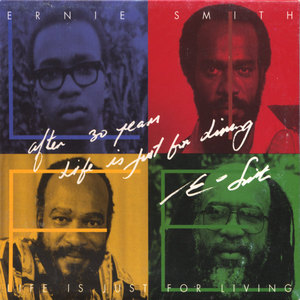
Put your hands on the remote! browse music »After 30 Years: Life is Just for Living by Ernie Smith
- sampleI Can't Take It, 1967
- sampleBend Down, 1971
- sampleRide On Sammy, 1971
- sampleGirl, 1971
- sampleOne Dream, 1971
- sampleSunday Morning, 1971
- samplePitta Patta, 1972
- sampleLife Is Just For Living, 1972
- sampleBad Woman, 1972
- sampleFootprints On the Ceiling, 1972
- sampleHail the Man, 1972
- sampleDuppy Gunman, 1974
- samplePlay De Music, 1974
- sampleElsaida, 1974
- sampleAll For Jesus, 1974
- sampleRebel Music, 1974
- sampleWe De People/the Power and the Glory, 1976
- sampleDon't Down Me Now, 1978
- sampleTo Behold Jah, 1978
- sampleTime, 1978
- sampleStay Awhile With Me, 1981
- sampleLet the Children Play, 1987
- sampleSinger Man, 1987
- sampleMr. Music, 1987
- sampleNew York You Going Crazy, 1989
- sampleI'm On Your Side, 1990
- sampleGetto Monday, 1992
- sampleDidn't Know We Were Poor, 1996
- sampleDon't Worry Mama, 1996
- sampleSister, 1996
- sampleDidn't Know We Were Poor, (a Capella) Featuring Word
If Neil Diamond sang Reggae, he would want to sound like Ernie Smith.
Unfortunately, this album is no longer available for sale.
Check below for similar albums or search for more music.
Bio / Background
Ernie, who is respected as a composer, lyricist and singer has a deep, rich voice Ernie Smith that draws comparisons to Neil Diamond and Cat Stevens.
Jamaican born reggae musician Ernie Smith comes to you with a catalogue spanning 37 years, 12 Albums, countless live performances and a significant fan base. Ernie Smith's professional musical career began with his first recording in 1967, an original composition - "I Can't Take It", later recorded by Johnny Nash as "Tears On My Pillow." Hits followed in quick succession, including "Bend Down," "Ride On Sammy," "One Dream," Pitta Patta" and "Duppy Gunman"Ernie has written well over 200 songs, some of which have been recorded by other artistes, including Johnny Nash, Rita Marley, Chakka Demus and Pliers, Twiggy, Ken Lazarus, John Jones, Eddie Lovette, and Yellow Man among others.
↓ more ↓Ernie played on many of the world stages including repeat performances at Madison Square Garden, New York (1973, 1974 and 1999); Place de Nacion, Montreal ; Camp Fortune, Ottawa ; Ontario Place, Alexandria Palace, Convocation Hall, Toronto ; The Martinez Ballroom, Cannes, Disney World, France; Rio , Brazil; Expo 93, Taejon, and Muju Resorts, Korea; Nippon Budokon Hall, Tokyo, Japan; Henry J. Bean Club, Brussels; San Marino, Milan, Rome, Italy ; venues in other European countries, including Holland , Switzerland, Germany; events on the East Coast of the USA and throughout middle-America including July Jam Festival, Lincoln, Nebraska; in Belize City, Central America; Georgetown, Guyana, South America and during other engagements in Caribbean countries, including Barbados, Trinidad, St Lucia, St. Vincent, St. Maarten, Cayman Islands and Jamaica .
As well as performing with Jamaica 's foremost bands, Ernie has the distinction of being Jamaica 's premier solo act, performing as far afield as Germany, Italy, South Korea, Switzerland, Holland, Belgium, France, UK and the USA.
rnie Smith's professional musical career began with his first recording in
1967, an original composition - "I Can't Take It", later recorded by Johnny
Nash as "Tears On My Pillow." Hits followed in quick succession,
including "Bend Down," "Ride On Sammy," "One Dream," and "Pitta Patta." Duppy Gunman"
In 1972 at the World Popular Song Festival of the Yamaha Foundation in
Tokyo, he won the grand prize competing with songwriters like Neil Sedaka, and Michael Legrand, with his original composition of "Life is Just for
Living."
Ernie became the first Jamaican musician to win an International award. For this historic achievement, he became the first musician in the field of Popular Music to be honoured by the Jamaican Government.
In 1976, Ernie was forced into exile in North America because of his
controversial political commentary in the song, "The Power and the Glory". Ironically, the once-banned song is still relevant and even more popular. Today, twenty-six years after its release it is the battle song for all the talk shows and community activists.
In the first 3 of the 13 years in exile from his homeland, he thrilled
audiences In Canada, where he resided for 3 years, and was a pioneer in bringing Reggae to the mainstream. Critics hailed his album "To Behold Jah" (1979) as "one of the most important albums to come out of Canada for [the] year [1979]."
↑ less ↑


fave it