Top tracks
Listeners also bought
Other New Age albums
Other Asian albums
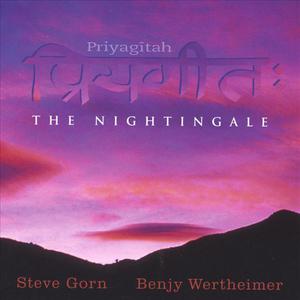
Put your hands on the remote! browse music »Priyagitah: The Nightingale by Benjy Wertheimer and Steve Gorn
view larger image
fave it New Age | Asian
8 tracks | 60 minutes
Released May 2004
on Wolf Cub Music
Click
for a 30-second preview. All tracks are 192kbps high fidelity sound quality. Protected WMA $0.77 or unprotected MP3 $0.88.
listen album 30sec. shuffle buy CD review album promote album
- sample lyrics "album only" 08:35 Rag Desh Part 1 lyrics "album only" 08:35 Rag Desh Part 1 lyrics "album only" 08:35 Rag Desh Part 1
- sample lyrics "album only" 04:50 Rag Desh Part 2 lyrics "album only" 04:50 Rag Desh Part 2 lyrics "album only" 04:50 Rag Desh Part 2
- sample lyrics "album only" 03:04 Rag Desh Part 3 lyrics "album only" 03:04 Rag Desh Part 3 lyrics "album only" 03:04 Rag Desh Part 3
- sample lyrics "album only" 23:17 Rag Madhuvanti Part 1 lyrics "album only" 23:17 Rag Madhuvanti Part 1 lyrics "album only" 23:17 Rag Madhuvanti Part 1
- sample lyrics "album only" 09:25 Rag Madhuvanti Part 2 lyrics "album only" 09:25 Rag Madhuvanti Part 2 lyrics "album only" 09:25 Rag Madhuvanti Part 2
- sample lyrics "album only" 03:19 Rag Bhairavi Part 1 lyrics "album only" 03:19 Rag Bhairavi Part 1 lyrics "album only" 03:19 Rag Bhairavi Part 1
- sample lyrics "album only" 06:16 Rag Bhairavi Part 2 lyrics "album only" 06:16 Rag Bhairavi Part 2 lyrics "album only" 06:16 Rag Bhairavi Part 2
- sample lyrics "album only" 01:27 Priyagitah lyrics "album only" 01:27 Priyagitah lyrics "album only" 01:27 Priyagitah
Transcendent Indian classical music featuring bamboo flute, esraj, tabla, and clarinet.
Bio / Background
Although Steve Gorn and Benjy Wertheimer had not yet
met, they'd been hearing about each other for nearly 20 years.
Finally,in January of 2001, Krishna Das invited them both
to Los Angeles to record on his CD, "Breath of the Heart."
During breaks in the recording schedule, they instantly began to play together. Music without words...esraj and flute weaving
the melodic contours of a raga...flute and tabla meeting in a spontaneous rhythmic dance. It was clearly the beginning of a deep and powerful musical relationship.
The bond and mutual respect grew as they toured the Northwestin 2002-03, and culminated with this recording of Indian ragas,along with an original piece for esraj and clarinet.
About The Ragas
The musical form at the heart of traditional Indian classical music, the raga or (or "rag," in modern Hindi/Urdu) has its roots in the Sanskrit "ranj," which means "to color."
It is sometimes said,"that which colors the mind is the raga." A raga defies simple definition.
↓ more ↓More than a scale, mode, tune or melody, it is a combination of elements-such as the modal structure, including the ascending and descending movement; the emphasis or avoidance of certain notes; the characteristic movements and motifs (the heart of the raga); the time of day
or season; and the moods of the raga.
These improvisational pieces were recorded live in the studio. To honor the form, they were improvised within the specific musical structure of each raga.
Rag Desh:
Traditionally played at night, Rag Desh (which translates to "country") is also
known as a rainy season raga. The primary moods expressed are devotion, romance and longing.
Rag Madhuvanti:
The word "madhu" means honey, and the sweetness of honey flows like a river through this raga. Rag Madhuvanti belongs to the group of late afternoon ragas, and was most likely created in the 1920s. The crimson colors of sunset and the coming evening give the raga an urgency and sense of longing. Unfolding slowly in "vilambit ektal" (a slow 12-beat cycle with each beat subdivided into four), this raga creates a mood that is settling, yet filled with expectation. It concludes with a faster section in teental (16 beats).
Rag Bhairavi:
Named in honor of the Goddess Bhairavi, this beloved raga embodies her qualities of devotion and compassion. The consort of Bhairav, (also portrayed as the God Shiva), Rag Bhairavi expresses feelings of romance and longing. Traditionally a morning raga, it can also be played any time of day or night. It's often the final raga in an Indian classical concert.
Priyagitah/The Nightingale:
The Sanskrit name for nightingale, "Priya" means "beloved" and "gita" is usually translated as "song." The two words together can mean both "one who sings to the Beloved"
and "song of the Beloved." This dialog between the clarinet and the esraj represents the musical flight of yearning for the One-the connection of the musician and the music.
↑ less ↑