Top tracks
Listeners also bought
Other Bebop albums
Other Traditional Jazz Combo albums
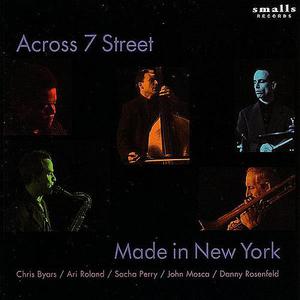
Put your hands on the remote! browse music »Made in New York by Across 7 Street
view larger image
fave it Bebop | Traditional Jazz Combo
12 tracks | 62 minutes
Released Feb 2004
on Smalls Records
Click
for a 30-second preview. All tracks are 192kbps high fidelity sound quality. Protected WMA $0.77 or unprotected MP3 $0.88.
listen album 30sec. shuffle buy CD review album promote album
- sample lyrics "DOWNLOAD" 04:40 You Think So? lyrics BUY MP3 04:40 You Think So? lyrics "GIFT MP3" 04:40 You Think So?
- sample lyrics "DOWNLOAD" 05:19 Having Tea with Swamp Thing lyrics BUY MP3 05:19 Having Tea with Swamp Thing lyrics "GIFT MP3" 05:19 Having Tea with Swamp Thing
- sample lyrics "DOWNLOAD" 04:03 Apollo 7 lyrics BUY MP3 04:03 Apollo 7 lyrics "GIFT MP3" 04:03 Apollo 7
- sample lyrics "DOWNLOAD" 05:48 St. Francis' Dimes lyrics BUY MP3 05:48 St. Francis' Dimes lyrics "GIFT MP3" 05:48 St. Francis' Dimes
- sample lyrics "DOWNLOAD" 04:56 Sundial lyrics BUY MP3 04:56 Sundial lyrics "GIFT MP3" 04:56 Sundial
- sample lyrics "DOWNLOAD" 04:51 We'll See lyrics BUY MP3 04:51 We'll See lyrics "GIFT MP3" 04:51 We'll See
- sample lyrics "DOWNLOAD" 06:52 Back in the Cosmos lyrics BUY MP3 06:52 Back in the Cosmos lyrics "GIFT MP3" 06:52 Back in the Cosmos
- sample lyrics "DOWNLOAD" 07:03 One for D.T. lyrics BUY MP3 07:03 One for D.T. lyrics "GIFT MP3" 07:03 One for D.T.
- sample lyrics "DOWNLOAD" 04:17 Need I Say More? lyrics BUY MP3 04:17 Need I Say More? lyrics "GIFT MP3" 04:17 Need I Say More?
- sample lyrics "DOWNLOAD" 04:05 Eleven Later lyrics BUY MP3 04:05 Eleven Later lyrics "GIFT MP3" 04:05 Eleven Later
- sample lyrics "DOWNLOAD" 04:57 Adriatic Sea lyrics BUY MP3 04:57 Adriatic Sea lyrics "GIFT MP3" 04:57 Adriatic Sea
- sample lyrics "DOWNLOAD" 05:27 Once lyrics BUY MP3 05:27 Once lyrics "GIFT MP3" 05:27 Once
The quintessential New York jazz quintet consists of five New York jazz prodigies, playing a smart, dark-edged, swinging, latter-day bebop, with original compositions characterized by sinuous original melodies and brilliant harmonies.
Editorial review
In jazz terminology, the term "front line" doesn't refer to wartime combat; the term refers to the horn players in a small group. Most front lines in jazz quintets consist of trumpet and sax, but rarely does one encounter a bop or post-bop front line that excludes the trumpet and opts for a sax/trombone union instead. However, the combination of tenor sax and trombone without a trumpet worked marvelously well for the Jazz Crusaders in the '60s, and it's a combination that Across 7 Street uses to their advantage on Made in New York. That isn't to say that this N.Y.C. group is in a class with the Jazz Crusaders or that Across 7 Street actually sounds like them, only that the tenor/trombone front line is a big part of this album's appeal. Tenor player Chris Byars and trombonist John Mosca are a likable combination, and the hard bop group has a solid rhythm section in pianist Sacha Perry, bassist Ari Roland, and drummer Danny Rosenfeld. To their credit, the musicians do all of the writing themselves -- they don't perform any overdone warhorses -- and the material has a strong '50s flavor. Made in New York is an appropriate title for this CD -- not only because it really was recorded in the Big Apple, but also because it fondly recalls a time when Bud Powell, J.J. Johnson, Max Roach, Art Taylor, and a young Sonny Rollins were all part of the Manhattan club scene. There is no acknowledgment of modal jazz, avant-garde jazz, jazz-funk, or fusion on this release; Made in New York is bop all the way, and the performances sound like they could have been recorded in 1953 or 1954 instead of 2002. While Made in New York falls short of mind-blowing, it's a solid and respectable, if derivative, outing that fans of '50s-style bop will enjoy. ~ Alex Henderson, All Music Guide
Bio / Background
Sunday night patrons didn't ride in on the Friday and Saturday night bandwagon. Sunday nights at Smalls were for listeners and people off the beaten path. They came to listen to the music and thumb their noses at Monday morning. For nine years, they came to Smalls every Sunday to hear Across 7 Street. The smart, dark-edged music of this quintessential New York jazz group was the perfect tonic, a reminder that there was intelligent life in the universe. The name of the group is an oblique reference to the unheralded passing of an underground legend, the late saxophonist Clarence "C" Sharpe, who performed with members of this group, and who made the abstract progression from the University of the Streets on one side of East 7th Street, to the Peter Jarema Funeral Home on the other side. The tribute might now be extended as well to the late Frank Hewitt.
The members of Across 7 Street were all born and raised in NY.
↓ more ↓All were early standouts, establishing themselves on the New York jazz scene in their teenage years. Chris, Ari, Sacha, and Danny excelled in Barry Harris' workshops in their early years, and learned much from accompanying the elder players on the New York scene at the time, players such as C Sharpe, Frank Hewitt, Junior Cook, Lou Donaldson, Vernel Fournier, and Tommy Turrentine. John Mosca, who is also the director of the Vanguard Jazz Orchestra, is the consummate veteran soloist, ensemble player, and teacher, a longtime pillar of the NY jazz scene. It is the unique blend of influences from the rich New York scene that gives this group its flavor. Over the course of nine years of weekly Sunday night features at Smalls, Across 7 Street developed an impressive book of fifty or so original compositions to maturity. This volume presents the first dozen of those compositions for the first time on record. The music is difficult, dark-edged, hard swinging, harmonically rich, and deeply rooted, and the listener is sure to be rewarded.
Luke Kaven
Ithaca, November 2003
Notes on the Music
You Think So? is typical Sacha Perry fare in that it's minor, very rhythmically identifiable, and on a set of chords you've never heard before but thought you had. I get a slight tongue-in-cheek humor hidden in this one somehow. Probably just from knowing Sacha.
Having Tea With Swamp Thing is a classic Ari Roland tune. There are two beats missing from the first A, an extra bar on the last A, and the last A starts with a drum solo. Over these form innovations, he makes a melody actually sound tuneful despite all kinds of rhythmic events, i.e., sixteenth notes in between sustained notes, heavy syncopations, and specific articulations.
Apollo 7 is a musical depiction of a ride in a space ship with one of the band members (could be any one of them!). It's quiet, intense, and you get around to some interesting topics quickly. For me, the highlight is the beginning of the bridge; the tenor winds up sitting on a flat 9 of a major chord for five beats, a very strange note indeed! Things resolve soon, as is typical with Byars compositions -- movement prevails over conflict.
Ari starts St. Francis' Dimes in with two A sections in B major, and a B section in E flat. The A sections are 12 bars long, giving it a blues feel, which releases comfortably to the 16 bar B. The cadenza section at the end is only loosely choreographed, and has evolved gradually over many Sunday nights at Smalls.
Sundial is a contrafact, a new melody based on a pre-existing chord structure. The harmonic sequence of the standard "Laura" was modified to include more dominant chords and favors chromatic movement over traditional fourths and fifths. The melody is formulated in a twelve-tone scheme: it runs the course of all twelve chromatic scale notes before any notes can repeated. However, the next set of twelve is always a new order, so any given note can reappear less than twelve notes later. This added flexibility makes for an easier application of the melody to the chord structure. Harmonies between the trombone and tenor count for two notes!
We'll See, originally titled "Tune in C" by Ari Roland, doesn't hang out in C for very long. The A sections start in the relative minor (A minor), bounce up to D minor, then take a rhythm-changes-like cycle. Ari has the rhythm section play one measure of stop time at the beginning of each A section. The bridge, also similar to "I Got Rhythm", starts in the III tonality. Ari opts for a major key and stays there for most of the 8 bar section. The horns are unusually voiced, with the trombone an octave higher for the A sections. It's unison the whole way until the last note. This might be the tune we played the most over the last ten years.
Back in the Cosmos is a conglomerate of ideas that were running around the jazz scene 10 years ago. The intro comes from a concept Jason Lindner and I were working on, fast arpeggiation that makes a melodic instrument sound like it can play more than one note at a time. It makes a couple of appearances during the tune as well. The rest of the tune is pure fun, with some melodic fragments donated by Zaid Nasser and William Ash, the bridge reminiscent of Bud Powell's "Parisian Thoroughfare".
One for D.T. is written in honor of author Dylan Thomas. His prismatic style is echoed in the melodic, harmonic and rhythmic elements of what must be one of the most challenging jazz tunes ever written. Through-composed, it begins in a "twin" tonality of Gb and C, runs a gauntlet through the keys of Ab, F, Eb Gb minor and D; eventually returns in the last 16 bars to its original double-location. The melody includes many "brash" notes typical of an Ari Roland composition. For instance, the second note is an augmented fifth on a major chord, resolving to a raised ninth of a dominant. Rhythmically, triplets of all sizes as well as a constant variation of note lengths offer a fascinating landscape.
On Need I Say More? Sacha turns up the rhythmic heat to explore the key of E flat minor in characteristic form. This one feels more minor to me, has a more serious edge. An interesting innovation here is the use of the III minor7(b5) chord in the third bar. We're all used to a IIIm7 VI7 IIm7 V7 progression, but not on a minor tune!
The title of Eleven Later refers to a period of years in Ari's life, not to a number of bars in a particular section of music as one might guess. This is the most offbeat cubist set of blues chords anyone has ever assembled, complete with an outrageously adventurous melody as the cherry on top. It's a lot of fun to play. One word of advice Ari gave to the band was to play the chords in the seventh measure not as a substitution, but as real chords in the far off key (it's an Em A7 in an A flat blues), which gives an interesting effect, something akin to the opposite of "leaning into a turn".
Adriatic Sea is a blues expanded to an A A B A form, that is to say, I added a bridge. The A sections are designed to bring out the brotherhood between the trombone and tenor saxophone, something good for a unison holler, with the exception of a tricky first ending. The bridge is a brief departure onto a carousel ride!
Ari's ballad, Once, has some of the gutsiest notes anybody ever wrote for a slow tempo. As a melody player, one has a choice to bring out or downplay the conflict between melody and harmony. He breaks every rule in the book here: major 7ths on dominant chords, heavily emphasized fourths, flat 9s and flat 3rds on major chords. A very deep tune worthy of study.
Chris Byars
New York, November 2003
↑ less ↑