Top tracks
Other Free Jazz albums
Other Contemporary albums
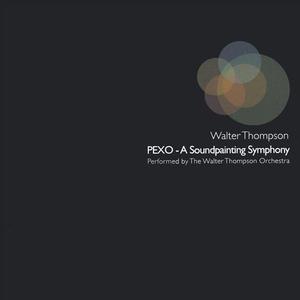
Put your hands on the remote! browse music »PEXO-A Soundpainting by Walter Thompson
view larger image
fave it Free Jazz | Contemporary
6 tracks | 50 minutes
Released Jul 2005
on Nine Winds
Click
for a 30-second preview. All tracks are 192kbps high fidelity sound quality. Protected WMA $0.77 or unprotected MP3 $0.88.
listen album 30sec. shuffle buy CD review album promote album
- sample "album only" 05:23 Entrance "album only" 05:23 Entrance "album only" 05:23 Entrance
- sample "album only" 05:53 Prepare "album only" 05:53 Prepare "album only" 05:53 Prepare
- sample "album only" 07:09 Get Ready "album only" 07:09 Get Ready "album only" 07:09 Get Ready
- sample "album only" 18:59 Bob Barker "album only" 18:59 Bob Barker "album only" 18:59 Bob Barker
- sample "album only" 04:41 The Crowd "album only" 04:41 The Crowd "album only" 04:41 The Crowd
- sample "album only" 08:49 Two Talk Show Hosts "album only" 08:49 Two Talk Show Hosts "album only" 08:49 Two Talk Show Hosts
PEXO-A Soundpainting is composed live using Walter Thompson's Soundpainting sign language for creating composition from structured improvisation.
Editorial review
Using a technique he calls "soundpainting," Walter Thompson composes the way a visual artist might approach a large canvas, with broad, sprawling strokes that mix colors in wildly rhythmic swirls. Thompson's "system" encourages musicians to improvise based on hundreds of different signals (approximately 90 of which are used here) that he conveys during a performance, not entirely dissimilar to Butch Morris' conduction technique or Anthony Braxton's approach to some of his large-scale projects. This version of Thompson's orchestra contains only a few names that are immediately recognizable, including trumpeter Rob Henke and trombonist Christopher Washburne, but Thompson builds on the strengths of the collective, using it in effect as his instrument, the way that Duke Ellington did. The six movements of "PEXO" are intended to aurally translate and spoof a trip to a television studio, and include a game show, a news program, recording crews, and preparation of the studio audience. The three actors speak the various parts, with the orchestra accompanying and often taking the lead. The composition can be listened to on at least two levels, as a sort of operatic drama with a loosely based plot, or simply as a stand-alone composition. Either perspective works for the most part, although the dramatic and often humorous voices of the actors and actresses are sometimes unrealistically formal. It is easy to imagine the theatrical versions of the piece being inherently easier to follow and much more satisfying, though the recording forces the listener to imagine the possibilities. From a strictly aural perspective, Thompson's gestures challenge the players to start and go, and engage in cacophonous interludes and clipped solos, often with wondrous results. With so much going on at one time the project runs the risk of imploding, but to Thompson's credit he maintains a stark discipline that keeps it all focused. He is particularly effective at integrating and interweaving complex spoken and instrumental lines. ~ Steven Loewy, All Music Guide
Bio / Background
Soundpainting is the composing/conducting sign language created by New York composer Walter Thompson for musicians, dancers, actors, poets, and visual artists working in the medium of structured improvisation. At present the language comprises more than 750 gestures that are signed by the composer/conductor indicating the type of improvisation desired of the performers. Direction of the composition is gained through the parameters of each set of signed gestures. Simply put, Soundpainting is live composition created through the use of a sign language. For more information on Soundpainting please visit Soundpainting.com
PEXO-A Soundpainting Symphony is a Soundpainting composition based on the concepts of games. Board games, politics, sports, television quiz shows, mind games, pranks, and children's games, among others. PEXO was first conceived as a theater work during a summer residence at the Byrdcliffe Arts Colony in Woodstock, NY.
↓ more ↓The theater version of PEXO incorporates musicians, dancers, actors, and visual artists. PEXO, the theater work, later premiered in New York City in March of 2002 at the HERE Arts Center.
PEXO-A Soundpainting Symphony is an aural representation of the theater work. The symphony is not intended to imitate an evening of the theater version but rather to extend the concept through the recording medium. PEXO is my abstracted sound vision of a visit to a television recording studio-seeing the taping of game shows, news programs, the personalities of the hosts, the technical crew making it happen, and the preparation of the audience and their required participation.
PEXO is composed in six movements, each related to the others through the repetition of specific Soundpainting gestures. There were approximately 90 gestures used to compose the entire symphony.
PEXO is a live composition, composed in its entirety during the recording session. There are no edits.
Walter Thompson - Composer, Conductor, Woodwinds, Educator
Born in West Palm Beach, Florida, Thompson spent his early years studying guitar, drums, and saxophone. He made his professional debut at age 12 playing drums with a trio that worked parties. Every summer from age 6 on, Thompson travelled with his family to Woodstock, New York. There he studied drawing at the Arts Student League and acting at the Woodstock Playhouse. Thompson's teenage years were spent performing in improvising rock bands. In 1970 Thompson began his studies at Berklee School of Music in Boston, Massachusetts.
In 1974, after attending a few years at Berklee School of Music, Thompson moved to his family's summer house in Woodstock, New York. There he received a grant from the National Endowment on the Arts to study composition and woodwinds with Anthony Braxton. Thompson's work over the next 5 years with Anthony Braxton was the most important of his life. During this period, he also studied dance improvisation with Ruth Ingalls in Woodstock. Woodstock in the 70s was a very exciting time for music. The Creative Music School (CMS), founded by Karl Berger, Don Cherry, and Ornette Coleman, was going strong. Great composers and performers such as John Cage, Ed Blackwell, Carlos Santana, Don Cherry, Anthony Braxton, and Carla Bley gave 2-week workshop/performances with the students. The CMS was closed during the summers, but many of the students remained in Woodstock. Thompson organized jam sessions with these students. Out of these sessions Thompson formed his first orchestra and produced a series of concerts at the Woodstock Kleinert Gallery. The focus of the orchestra was on large-group jazz-based improvisation. It was during these early days that Thompson began experimenting with signing improvisation. He created very basic gestures, asking for a long tone or improvisation in a pointillist style, for example."
Thompson moved to New York City in 1980 and formed The Walter Thompson Big Band (now The Walter Thompson Orchestra) in 1984. During the first year with his orchestra, while conducting a performance in Brooklyn, New York, Thompson needed to communicate with the orchestra in the middle of one of his compositions. They were performing a section of improvisation where trumpet 2 was soloing. During the solo Thompson wanted to have one of the other trumpet players create a background. Not wanting to emulate bandleaders who would yell or speak out loud to their orchestra, Thompson decided to use some of the signs he had experimented with during his Woodstock days. In the moment he made up these signs: Trumpet 1, Background, With, 2-Measure, Feel; Watch Me, 4 Beats. He tried it and there was no response! But in the next rehearsal, members of his orchestra asked what the signing was about - and he told them. The orchestra members thought it was a very interesting direction and encouraged Thompson to continue to develop the language further. During the next 10 years, Thompson developed Soundpainting into a comprehensive sign language for creating composition from structured jazz-based improvisation. In the early 90s Thompson began developing Soundpainting with actors, dancers, poets, and visual artists.
Over the past 15 years Thompson has taken Soundpainting into music and art education, to conservatories, universities, and schools throughout the world. Soundpainting has evolved into a universal sign language for live composition in which music, theater, dance, and film scores can be realized spontaneously.
Thompson has composed/conducted Soundpaintings with contemporary orchestras in many cities around the world including Barcelona, Paris, Oslo, Berlin, Bergen, Copenhagen, and Reykjavik and has taught Soundpainting at the Paris Conservatoire, Eastman School of Music, Iceland Academy of the Arts, University of Michigan, University of Iowa, Oberlin College-Conservatory of Music, and New York University among many others. Thompson is founder of and composer/conductor for The Walter Thompson Orchestra, based in New York City. The Orchestra has been together for more than 20 years and has been the key vehicle for Thompson's Soundpainting.
Thompson has received awards from various organizations, including the Rockefeller Foundation, The University of Iowa ("Ida Cordelia Beam Distinguished Visiting Professor"), the Mid Atlantic Arts Foundation ("Artist as Catalyst"), the Jerome Foundation, Meet the Composer/Reader's Digest/Lila Atchison Wallace Commissioning Program, the National Endowment for the Arts, the Mary Flagler Cary Charitable Trust, The American Society of Composers, Authors and Publishers, and the New York State Council on the Arts. In 2002 Thompson was presented with the prestigious Aplaudiment from Premis FAD Sebastià Gasch d'Arts Parateatrals in Barcelona, Spain, for his work with Soundpainting.
↑ less ↑