Top tracks
- Epilogue: May I Suggest
- did trouble me
- Time Between Trains
- Barbed Wire Boys
- Maybe If I Sang Cole Porter
Listeners also bought
Other Jazz Vocals albums
Other like Joni albums
Blues Babe by Olga
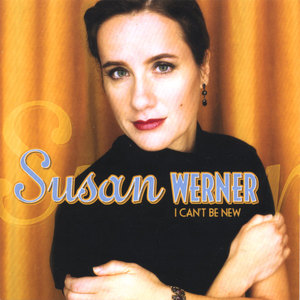
I Can't Be New by Susan Werner
view larger image
fave it Jazz Vocals | like Joni
13 tracks | 40 minutes
Released Nov 2006
on Susan Werner
Click
for a 30-second preview. All tracks are 192kbps high fidelity sound quality. Protected WMA $0.77 or unprotected MP3 $0.88.
listen album 30sec. shuffle buy CD review album promote album
- sample lyrics "DOWNLOAD" 02:54 I Can't Be New lyrics BUY MP3 02:54 I Can't Be New lyrics "GIFT MP3" 02:54 I Can't Be New
- sample lyrics "DOWNLOAD" 03:36 Late for the Dance lyrics BUY MP3 03:36 Late for the Dance lyrics "GIFT MP3" 03:36 Late for the Dance
- sample lyrics "DOWNLOAD" 02:41 Seeing You Again lyrics BUY MP3 02:41 Seeing You Again lyrics "GIFT MP3" 02:41 Seeing You Again
- sample lyrics "DOWNLOAD" 04:15 I'm Not Sure lyrics BUY MP3 04:15 I'm Not Sure lyrics "GIFT MP3" 04:15 I'm Not Sure
- sample lyrics "DOWNLOAD" 04:08 Much at All lyrics BUY MP3 04:08 Much at All lyrics "GIFT MP3" 04:08 Much at All
- sample lyrics "DOWNLOAD" 03:01 Tall Drink of Water lyrics BUY MP3 03:01 Tall Drink of Water lyrics "GIFT MP3" 03:01 Tall Drink of Water
- sample lyrics "DOWNLOAD" 03:13 You Come Through lyrics BUY MP3 03:13 You Come Through lyrics "GIFT MP3" 03:13 You Come Through
- sample lyrics "DOWNLOAD" 02:58 No One Needs to Know lyrics BUY MP3 02:58 No One Needs to Know lyrics "GIFT MP3" 02:58 No One Needs to Know
- sample lyrics "DOWNLOAD" 02:45 Let's Regret This in Advance lyrics BUY MP3 02:45 Let's Regret This in Advance lyrics "GIFT MP3" 02:45 Let's Regret This in Advance
- sample lyrics "DOWNLOAD" 03:05 Don't I Know You lyrics BUY MP3 03:05 Don't I Know You lyrics "GIFT MP3" 03:05 Don't I Know You
- sample lyrics "DOWNLOAD" 02:53 Philanthropy lyrics BUY MP3 02:53 Philanthropy lyrics "GIFT MP3" 02:53 Philanthropy
- sample lyrics "DOWNLOAD" 02:54 Stay on Your Side of Town lyrics BUY MP3 02:54 Stay on Your Side of Town lyrics "GIFT MP3" 02:54 Stay on Your Side of Town
- sample lyrics "DOWNLOAD" 01:46 Coda: Maybe if I Sang Cole Porter lyrics BUY MP3 01:46 Coda: Maybe if I Sang Cole Porter lyrics "GIFT MP3" 01:46 Coda: Maybe if I Sang Cole Porter
George Gershwin. Cole Porter. Richard Rodgers. They say no one can write like that anymore, but Susan Werner has added a new chapter to the Great American Songbook. All Music Guide: "...brilliantly constructed, soulful, and cleverly tender..."
Editorial review
Susan Werner's Koch debut, and her sixth outing overall, is a collection of self-penned tunes in the manner, spirit, and flavor that spending a late night working in an office on Tin Pan Alley might provide. There is a beautiful, smoky, jazzy feeling that reminds one simultaneously of Hoagy Carmichael's more laid-back moments, Jerome Kern's humor, and the deep nostalgic atmospherics of Tom Waits' early Tin Pan Alley-influenced material -- without the barfly surrealism. That said, Werner's latest is a thoroughly modern recording. From the opening piano shimmers of the title track, which opens the disc, she comes out with it straightaway -- "Coffee, ham and eggs/I can be your dinner" -- and seemingly throws all notions of modern-day PC lyric acceptability to the wind, thank god. Werner's lyric sensibility keeps its wit and never gives up the dignity of her protagonist as she states in a matter of fact way that she can be all things but new. It's a beautiful line in the sand that listeners don't hear much anymore in American song. This isn't defiance; it's simply acceptance and a humorous but profound truth. All the best pop songs have them. This album is full of them. On "Late for the Dance," a bowed bass and clarinet accompany her piano and vocal as she offers a tale of love's regret that is full of whimsy and pondering of what might have been. The full-fledged swing of "Seeing You Again" -- complete with the effect of a scratchy 78-rpm record under the opening vocal for effect -- erases time and space considerations and instead iterates the song as a finely crafted work that situates the listener in a place of ease and empathy. But these three cuts offer just a glimpse through the window of the completely contemporary setting of "I'm Not Sure," with its smoky, sultry flamenco-styled guitar, string quartet, solo cello, mandolin, and shadowy hand percussion negotiating the terrain between the blues, fado, and sultry bossa nova. Likewise, "No One Needs to Know," where Werner is accompanied only by her guitar and Eugene Friesen's cello, is a torch ballad whispered in the stillness of a love furtively begun and acceded to. In its secret lies its possibility. The finger-popping standup bass and jazzed-up "doo wee" choruses in "Philanthropy," with Dave Mattacks' hand percussion, invert the entire Tin Pan Alley instrumental dictum by stripping everything to the barest notion of song itself -- and what a song. This 13-song set closes with that same 78 lisping in the background as Werner's voice comes across the void singing a husky, brazen love song that offers up her shortcomings as possibilities for gaining the other's devotion; yet they are always in the realm of "maybe if I did," not "if I do." She's accepting her protagonist for who she is, and it's enough for the truth of the song; whatever the desired other wants is immaterial. The piano may not quite assent to her vocal in its wistful shapes and dulcet tonal wishes, but the singer's merely nodding to it in the corner of an empty room, singing and playing into the night, out of that same office on Tin Pan Alley. The cycle is complete, the tunes have been written, and it's time to go home. This is a brilliantly constructed, soulful, and cleverly tender effort by a songwriter and musician who is in such complete command of her gifts that it's almost scary. In a sense it's fair to say that listeners should forget everything they know of Susan Werner and encounter her now, in the fully present articulation of her considerable gifts. ~ Thom Jurek, All Music Guide
Bio / Background
With 6 albums under her belt, an active touring career throughout the U.S. and a string of accolades from the likes of The Washington Post, The Village Voice and The New Yorker, Susan Werner has become one of the defining artists of the folk music genre. Her songs effortlessly slide between folk, jazz and pop and are delivered with a sassy wit and classic midwestern charm.
Farm girl Susan Werner was raised in rural Iowa but began her professional music career in Philadelphia, after studying classical voice at Temple University. Inspired by a Nanci Griffith concert, Werner left behind her opera training and began performing as a singer-songwriter at coffeehouses throughout the northeast. She self-released her first album "Midwestern Saturday Night" in 1992 and then went on to put out "Live at Tin Angel" the following year. In 1995 came her breakout album, BMG/Private Music's "Last of the Good Straight Girls," but a corporate reshuffle left her and her folk-pop masterpiece behind.
↓ more ↓Werner went on, recording two albums even better than her previous work, adding some country and soul sounds to her signature vocal stylings with the help of Nashville multi-instrumentalist and songwriter Darrell Scott, who produced "Time Between Trains" and Colin Linden (Blackie & The Rodeo Kings), who produced her 2001 "New Non-Fiction."
Always ready to reinvent herself, in 2004 Susan Werner released her album of instant songbook classics "I Can't Be New" on Koch Records. For years she incorporated cabaret-style numbers in her live performances, exchanging her guitar for a piano (when there was one to be had), and she'd been asked by her audience to put all those songs in one recording. Fans and critics alike sang her praises: the All Music Guide calling it "a brilliantly constructed, soulful, and cleverly tender effort by a songwriter and musician who is in such complete command of her gifts that it's almost scary."
In 2005 Susan Werner made a splash on satellite radio and in the blogosphere with her "alternative national anthem" entitled "My Strange Nation." For this song, Werner adopted the musical style of a battle hymn, and added lyrics that encompass both the poetry and hypocrisy innate to the United States.
Early 2007 will bring the release of her latest endeavor, a yet untitled hymnal for the spiritually ambivalent. This collection of new material will include styles ranging from traditional bluegrass gospel, in songs such as "My Lord Will Trouble Me," to a hand clapping rouser for agnostics called "Probably Not."
As Howard Reich, chief critic of the Chicago Tribune, wrote in 2006: "Werner is one of the most innovative songwriters working today."
- Ellen Stanley
↑ less ↑