Top tracks
Listeners also bought
Other World Fusion albums
Other African- West albums
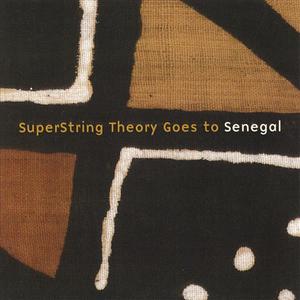
Put your hands on the remote! browse music »SuperString Theory Goes To Senegal by SuperString Theory
view larger image
fave it World Fusion | African- West
11 tracks | 66 minutes
Released May 2007
on Worldsoul Records
Click
for a 30-second preview. All tracks are 192kbps high fidelity sound quality. Protected WMA $0.77 or unprotected MP3 $0.88.
listen album 30sec. shuffle buy CD review album promote album
- sample lyrics "DOWNLOAD" 07:19 Aliwu Mix lyrics BUY MP3 07:19 Aliwu Mix lyrics "GIFT MP3" 07:19 Aliwu Mix
- sample lyrics "DOWNLOAD" 05:40 Dream Harder lyrics BUY MP3 05:40 Dream Harder lyrics "GIFT MP3" 05:40 Dream Harder
- sample lyrics "DOWNLOAD" 04:31 Konkoba lyrics BUY MP3 04:31 Konkoba lyrics "GIFT MP3" 04:31 Konkoba
- sample lyrics "DOWNLOAD" 04:02 Jump 12 lyrics BUY MP3 04:02 Jump 12 lyrics "GIFT MP3" 04:02 Jump 12
- sample lyrics "DOWNLOAD" 07:08 Sobobade lyrics BUY MP3 07:08 Sobobade lyrics "GIFT MP3" 07:08 Sobobade
- sample lyrics "DOWNLOAD" 05:22 Toubab lyrics BUY MP3 05:22 Toubab lyrics "GIFT MP3" 05:22 Toubab
- sample lyrics "DOWNLOAD" 05:57 Ndank Ndank lyrics BUY MP3 05:57 Ndank Ndank lyrics "GIFT MP3" 05:57 Ndank Ndank
- sample lyrics "DOWNLOAD" 05:37 Nouria lyrics BUY MP3 05:37 Nouria lyrics "GIFT MP3" 05:37 Nouria
- sample lyrics "DOWNLOAD" 05:45 Goats On The Roof lyrics BUY MP3 05:45 Goats On The Roof lyrics "GIFT MP3" 05:45 Goats On The Roof
- sample lyrics "DOWNLOAD" 07:23 Nyo Ko Bok lyrics BUY MP3 07:23 Nyo Ko Bok lyrics "GIFT MP3" 07:23 Nyo Ko Bok
- sample lyrics "DOWNLOAD" 08:13 Tarot Card lyrics BUY MP3 08:13 Tarot Card lyrics "GIFT MP3" 08:13 Tarot Card
Electric violin meets West African hoddu, balafon, talking drum and kora, Ethiopian singing - a percussive and melodic world fusion extravaganza featuring Derrik Jordan and some fantastic African and American musicians.
Bio / Background
How this CD came to be:
Sobobade is a Haitian word that means “the God who welcomes in all the other Gods.” It’s also the name of a hotel and artist retreat in Senegal, West Africa in the coastal town of Toubab Dialaw, a small fishing village about an hour south of Dakar. Tony Vacca, the leader of the world fusion band World Rhythms, of which I’m a member, invited me to join him as part of the Senegal-America Project, a group that works to bridge the two cultures. We spent a total of 12 days in early 2006 traveling with 17 people, mostly educators who teach about Africa in their classrooms but had never been there. This was my second trip to Africa; my first was to Ghana in 2000 to study drumming.
Sobobade is absolutely magical. Set on a small cliff overlooking the ocean, it is an artist’s vision of an artistic paradise.
↓ more ↓Created by Haitian artist Gerard Chenet, it has a variety of buildings where people can rent rooms and all of the buildings are meticulously and beautifully covered with mosaics of shells and stone. Sculptures are everywhere you look, hidden among lush tropical plants in the courtyards. There is an outdoor amphitheater for performances, a restaurant and vendors selling masks, clothes, mud cloths, paintings and drums to the mostly European tourists.
We arrived late at night. As I tumbled out of our overcrowded bus I instinctively felt we were somewhere special. I went to my room and began composing music immediately. Exotic places often have that affect on me. The piece I wrote that first night I called Sobobade in honor of the place. Each night after a full day of activities which included drumming, dancing, swimming and watching an amazing 20 member Senegalese dance company and 7 member drumming group prepare a new piece for performance, I would go back to my tiny room around midnight and begin composing. I wrote four pieces while I was there - Sobobade, Ndank Ndank (“Little By Little”), Dream Harder and Toubab (“White Man”).
Every morning I would awaken to the distant, crackling sounds of the singer calling the people to prayer. Most people in Senegal are Muslims. Each day upon awakening I would exclaim to myself in disbelief “I’m in Africa!” I couldn’t wait to get up and experience the music and culture that surrounded me.
I had the good fortune while I was there to record and work with some fabulous musicians. Pape Sakho plays the kora, a traditional West African harp. On the CD he performs Konkoba (“Mountain”), and Nouria (“Farmer”), which are traditional songs from Mali. Barou Sall is considered to be the finest hoddu player in Senegal. The hoddu is a small West African banjo and Barou performs regularly with Baaba Maal in his acoustic band. Nyo Ko Bok (“You’re Welcome” or literally “We Share It”) began as an improvised duet for hoddu and electric violin recorded at Baaba Maal’s studio in Dakar. I also recorded CDs for Pape and Barou of their own traditional music. Most of what we recorded was done in a room overlooking the ocean and you can hear the waves crashing in the background. I also recorded and gave CDs to the Sobobade Drummers who were accompanying the resident dance troupe, Moises Agnessa, a singer-songwriter and amazing dancer and Massamba Diop, our gracious host and celebrated tama (talking drum) player who has performed with Baaba Maal for 20 years.
I returned to the States bursting with inspiration and began recording the music I had written there and adapting some of the music that I had recorded there by adding other instruments. In Aliwu Mix, Barou Sall’s hoddu part is excerpted from a traditional piece called Aliwu Loume that I recorded at Sobobade. Goats On The Roof is a medley that I put together from an excerpt of a traditional drumming piece called Ngirigne performed by the Sobobade Drummers, which I recorded in the outdoor amphitheater in Sobobade one evening. I have combined it with a traditional kora song from Mali called Adiji Mariama performed by Pape Sahko, to which I added violin, riity and percussion.
Back in Vermont my daughter Sheyna Rose introduced me to her Ethiopian friend, the immensely talented Helen Kerlin-Smith, an orphan who has been adopted by a local family. She was 16 when she recorded Aliwu Mix and told me that she began singing in nightclubs in Addis Ababa, Ethiopia when she was 14. A naturally gifted and dedicated singer, I am certain that she is bound for greatness. Helen sings in her native language of Amharic. The lyrics to Aliwu Mix are about finding someone to love and not wanting to be apart from that love. Sobobade’s lyrics are about someone who longs for their homeland of Ethiopia.
The irony of discovering Helen Kerlin-Smith in my Vermont hometown after traveling thousands of miles to Senegal in search of exciting musicians to work with is not lost on me.
Derrik Jordan, Winter 2007
↑ less ↑