Top tracks
Listeners also bought
Other Folk Blues albums
Other Guitar Blues albums
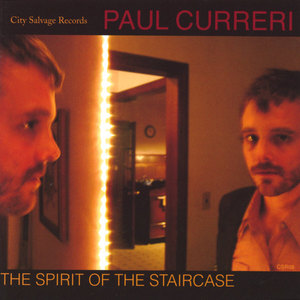
Put your hands on the remote! browse music »The Spirit of the Staircase by Paul Curreri
view larger image
fave it Folk Blues | Guitar Blues
11 tracks | 35 minutes
Released Dec 2004
on City Salvage Records
Click
for a 30-second preview. All tracks are 192kbps high fidelity sound quality. Protected WMA $0.77 or unprotected MP3 $0.88.
listen album 30sec. shuffle buy CD review album promote album
- sample lyrics "DOWNLOAD" 02:13 Beauty Fades lyrics BUY MP3 02:13 Beauty Fades lyrics "GIFT MP3" 02:13 Beauty Fades
- sample lyrics "DOWNLOAD" 03:46 Drag Some Revelating lyrics BUY MP3 03:46 Drag Some Revelating lyrics "GIFT MP3" 03:46 Drag Some Revelating
- sample lyrics "DOWNLOAD" 03:29 On the Fiddle lyrics BUY MP3 03:29 On the Fiddle lyrics "GIFT MP3" 03:29 On the Fiddle
- sample lyrics "DOWNLOAD" 02:21 March Kitchen and What Was Said lyrics BUY MP3 02:21 March Kitchen and What Was Said lyrics "GIFT MP3" 02:21 March Kitchen and What Was Said
- sample lyrics "DOWNLOAD" 04:01 Memory Makes All This lyrics BUY MP3 04:01 Memory Makes All This lyrics "GIFT MP3" 04:01 Memory Makes All This
- sample lyrics "DOWNLOAD" 04:22 Middledrift's Lament lyrics BUY MP3 04:22 Middledrift's Lament lyrics "GIFT MP3" 04:22 Middledrift's Lament
- sample lyrics "DOWNLOAD" 03:21 Something Comes lyrics BUY MP3 03:21 Something Comes lyrics "GIFT MP3" 03:21 Something Comes
- sample lyrics "DOWNLOAD" 03:19 The Party at the House lyrics BUY MP3 03:19 The Party at the House lyrics "GIFT MP3" 03:19 The Party at the House
- sample lyrics "DOWNLOAD" 03:09 Spirit of the Staircase lyrics BUY MP3 03:09 Spirit of the Staircase lyrics "GIFT MP3" 03:09 Spirit of the Staircase
- sample lyrics "DOWNLOAD" 03:11 Charlie Bear lyrics BUY MP3 03:11 Charlie Bear lyrics "GIFT MP3" 03:11 Charlie Bear
- sample lyrics "DOWNLOAD" 02:17 You Will Look at Me lyrics BUY MP3 02:17 You Will Look at Me lyrics "GIFT MP3" 02:17 You Will Look at Me
When a year's stereos suddenly blared more Duke than Reverend Gary, along came Curreri and his Virginia guitar's 3rd record, selected players loving and aching and banging beside him.
Bio / Background
Paul Curreri, the twenty-eight-year-old guitarist and songwriter from Virginia, unveiled his third album, The Spirit Of The Staircase, on December 18th on City Salvage Records.
Curreri's previous effort, 2003's Songs For Devon Sproule (City Salvage Records) was produced by internationally renown singer/guitarist Kelly Joe Phelps to wide critical acclaim. Phelps, who offered the same Vancouver, WA home studio where he had recorded his own two solo Rykodisc albums Roll Away The Stone and Shine Eyed Mister Zen, presented Curreri accompanying himself on acoustic guitar. "The first time I saw him play I was just blown away," says Phelps. "Paul's songs were incredible, his guitar playing was amazing. . .undeniable stuff." The resulting effort was an album of primarily original material nourished by, but not slavish to, the country-blues and folk traditions which lie at the heart of Curreri's musical influence.
↓ more ↓
On The Spirit Of The Staircase Curreri teams up with frequent collaborator Jeff Romano, who produced and performed on Curreri's first record, 2002's From Long Gones To Hawkmoth (City Salvage Records). Romano, an esteemed musician and craftsman in his own right, began searching for a new variety of musical accompaniment to compliment Curreri's lone guitar. "We worked to create a new sonic space in which Paul's songs could exist," says Romano, "selecting an ensemble of local studio musicians who added spice to Paul's sauce."
In what may be Curreri's most eloquent musical statement to date, the level of pure sonic invention permeating The Spirit Of The Staircase echoes the level of craft, insight and risk for which the young musician, at the relative beginning of a career, has already been credited. "It's a rare find to catch a young guy who can play this well, have his own voice as a singer, and write songs that are as interesting as anything out there," says Vintage Guitar magazine.
With equal parts somber and playful, the songs on The Spirit Of The Staircase present Curreri grappling with his attempts to make sense of a life devoted to making music and living on the road. "I'd been touring a lot these past few years, finally making it to Europe and feeling some green slip away," says Curreri. "Music was paying the rent and life was good, but somewhere along the way, I'd forgotten where I put the old happiness and love for writing, the big treasure." The result was "Something Comes," a composition which features Curreri on electric guitar. The rolling, countrified brush and snare beat accompany both Curreri's heroic electric riffs and his trademark delta-influenced finger-style acoustic lead. "I remembered how Duke Ellington's "Azalea" makes me want to cry, and the joy of John Hartford and John Fahey reminded me that I still love and have faith in the barebones of what I do." In "Something Comes" Curreri sings, "Just when faith is bending/ so very heavy from the aching / something comes and wakes you like you used to wake / way back before you knew what waiting was."
Curreri describes many of the songs on The Spirit Of The Staircase as "an apology to myself for momentarily misplacing my faith that goodness and light will come in again, as it always has." Some songs approach this idea with a certain amount of desperate humor. In "Drag Some Revelating" Curreri sings, "Spending/ Counting chickens often necessitates the touching of your chickens. / Who wants some sick and dirty old bird?" The first startling, unexpected hit of the snare drum announces the welcomed presence of the wide assortment of instrumentation which brings the songs on The Spirit Of The Staircase to life.
In "Middledrift's Lament" Curreri again finds humor in feeling washed up, accompanying himself on git-banjo with a drum and upright bass rhythm section hot on the heels of his ragtime beat. "Find my shoes and amble home / And buy me a weight set. / Lift something up, then put it back down. / I won't bother no one," Curreri sings, following a bridge which spills psychodelic wails from an array of instruments including bass harmonica, calliope, talking violin, tuba and trombone before the band falls back into the song's original line-up.
Other songs, like "Beauty Fades," the album's first track, exist "smack in the middle of the big empty," Curreri laughs. "That piece is about being beaten, quitting the search for the old spark, and asking folks close by to go on without you." Curreri, accompanying himself on acoustic guitar in what is the album's most melancholy composition, sings, "Beauty fades / and so mine has done. / Here's another spent book of matches / in the setting sun."
Curreri titled his third album The Spirit Of The Staircase after a French expression l'esprit d'escalier, which means: Things you think to say after it's too late and you're on your way out the door. "Ridiculous, but that's how I'd been feeling," says Curreri, "like I was on my way to burning out, that I'd wasted all of my youthful juice booking rental cars instead of watching the mountain change colors outside my window, not to mention actually walking toward the mountain."
Raised in Richmond, Virginia, Paul now makes his home in Charlottesville. He grew up playing music but ended up enrolling at Rhode Island School of Design to pursue painting and film. While Curreri credits his experiences at art school with developing his ability to observe and record the visual world, soon his true passion began to rise to the surface. By the time Paul graduated from RISD, he'd composed over 200 songs on guitar and piano. Turning down a job at MTV he set to work carving out a life as a musician. His acclaimed debut for City Salvage Records, From Long Gones To Hawkmoth, was released in 2002. A triumphant follow-up, Songs For Devon Sproule is a driving album full of rainy day elegance and late night wit.
The Spirit Of The Staircase finds the artist shouldering into new lyrical and musical terrain. "It was a natural and cleansing progression to bring in other players," Curreri says, "to give my ear some place to say, 'I need a minute. Can I leave my guitar here? I'm going for a walk.' This record is what I meant to say, and how I wanted to say it."
↑ less ↑