Top tracks
Listeners also bought
Other Free Jazz albums
Other Bebop albums
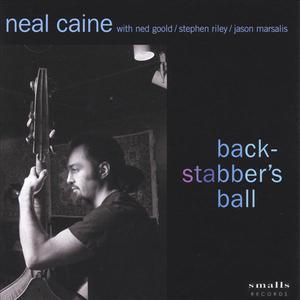
Put your hands on the remote! browse music »Backstabber's Ball by Neal Caine
view larger image
fave it Free Jazz | Bebop
15 tracks | 65 minutes
Released Apr 2005
on Smalls Records
Click
for a 30-second preview. All tracks are 192kbps high fidelity sound quality. Protected WMA $0.77 or unprotected MP3 $0.88.
listen album 30sec. shuffle buy CD review album promote album
- sample lyrics "DOWNLOAD" 01:03 intro lyrics BUY MP3 01:03 intro lyrics "GIFT MP3" 01:03 intro
- sample lyrics "DOWNLOAD" 05:52 D E A lyrics FREE 05:52 D E A lyrics "GIFT MP3" 05:52 D E A
- sample lyrics "DOWNLOAD" 07:11 Good Goooold lyrics BUY MP3 07:11 Good Goooold lyrics "GIFT MP3" 07:11 Good Goooold
- sample lyrics "DOWNLOAD" 00:38 W M D interlude lyrics BUY MP3 00:38 W M D interlude lyrics "GIFT MP3" 00:38 W M D interlude
- sample lyrics "DOWNLOAD" 08:30 W M D lyrics BUY MP3 08:30 W M D lyrics "GIFT MP3" 08:30 W M D
- sample lyrics "DOWNLOAD" 03:33 Late Night Living lyrics BUY MP3 03:33 Late Night Living lyrics "GIFT MP3" 03:33 Late Night Living
- sample lyrics "DOWNLOAD" 02:57 Corporate Jazz lyrics BUY MP3 02:57 Corporate Jazz lyrics "GIFT MP3" 02:57 Corporate Jazz
- sample lyrics "DOWNLOAD" 06:33 Conversation For Two lyrics BUY MP3 06:33 Conversation For Two lyrics "GIFT MP3" 06:33 Conversation For Two
- sample lyrics "DOWNLOAD" 00:51 W M D interlude lyrics BUY MP3 00:51 W M D interlude lyrics "GIFT MP3" 00:51 W M D interlude
- sample lyrics "DOWNLOAD" 07:38 Crescent City Reflections lyrics BUY MP3 07:38 Crescent City Reflections lyrics "GIFT MP3" 07:38 Crescent City Reflections
- sample lyrics "DOWNLOAD" 04:12 Clare Evermore lyrics BUY MP3 04:12 Clare Evermore lyrics "GIFT MP3" 04:12 Clare Evermore
- sample lyrics "DOWNLOAD" 00:58 W M D interlude lyrics BUY MP3 00:58 W M D interlude lyrics "GIFT MP3" 00:58 W M D interlude
- sample lyrics "DOWNLOAD" 05:04 The Hempire Strikes Back lyrics BUY MP3 05:04 The Hempire Strikes Back lyrics "GIFT MP3" 05:04 The Hempire Strikes Back
- sample lyrics "DOWNLOAD" 09:48 Backstabber's Ball lyrics BUY MP3 09:48 Backstabber's Ball lyrics "GIFT MP3" 09:48 Backstabber's Ball
- sample lyrics "DOWNLOAD" 01:01 outro lyrics BUY MP3 01:01 outro lyrics "GIFT MP3" 01:01 outro
The satisfying big sound on bass will appeal to avant-garde listeners and bebop lovers alike. Smart stuff. Sounds suite.
Editorial review
When one considers that the musicians on this quartet date are each associated, to an extent, with the New Orleans Young Lions and modern jazz movements, this music is rather surprising. There are no hints of parade rhythms; instead the result is a modern form of cool jazz. Bassist Neal Caine, who wrote all of the selections which sport original chord changes, keeps the group under tight control, although there are individual heroics and a few brief explosive moments. The tenors of Ned Goold and Stephen Riley have similar tones and styles, while Riley occasionally switches to alto clarinet for variety. Drummer Jason Marsalis is pretty laid-back for the most part, except for a few moments. This music has similarities to the type of cool jazz heard in Sweden in the 1950s although it is not an exact duplicate of anything. The "Intro," "Outro" and three "W M D Interludes" make the set unfold like a suite, and it holds one's interest throughout. Neal Caine's Backstabber's Ball is an excellent and fresh example of modern swinging jazz. ~ Scott Yanow, All Music Guide
Bio / Background
If you ask Neal Caine about his musical background, you won't get much of an answer at first. What would be the point? Where others might recite credentials and degrees, Neal just shrugs it off. To the rest of the world it seems that after being born in St. Louis in 1973, Neal just emerged full-blown at age 20, joining Elvin Jones band in 1994, where he played for three years alongside the grand master in a position formerly occupied by the late Jimmy Garrison. But he even shrugs that off. He's not trying to be mysterious. Better for the music to speak for itself each time out. Lest anyone think getting there is easy, though, it's best to point out that Neal began on the Suzuki Method at age 3, and has been making music since. By the time he arrived at Tulane in 1991 to study political science, he was already good enough as a bassist to be popular among musicians on the New Orleans scene, playing with Nicholas Payton, Ellis Marsalis, Brian Blade, and Donald Harrison, among others.
↓ more ↓Since his career-making stint with the Elvin Jones band, he's been the top pick on bass among vocal stars, spending a year with Betty Carter, a year with Diana Krall, and in the past few years as the driving pulse of the Harry Connick Jr. orchestra.
Touring frequently brought Neal to establish a kind of dual residency between New York and New Orleans, and he has thus been a strong presence on both scenes for some time. On breaks, Neal would often end up working at Smalls. Being the sideman the cats wanted to get when they could, he ended up working often with the Smalls regulars including Gregory Tardy, Sherman Irby, Charles Owens, Claudia Acuña, Myron Walden, Joe Magnarelli, Sacha Perry, Daniel Freedman, Zaid Nasser, Frank Hewitt, and Ned Goold, himself featured on this release.
I've heard the word "intuitive" used more than once by other musicians to describe Neal's playing. It is a discernable quality. This seems to be continuous with his origins as a Suzuki student, and with his inclinations towards a self-guided education. An understanding of the virtues of this approach might be found in John Dewey's philosophy of education, which hold self-educating among its ends, and emphasizes the primacy of praxis. Perhaps this explains why playing is as intuitive to Neal as speaking, and why the scholastic inhibition and self-consciousness that plagues so many others is nowhere present. Suzuki might say that this is just so.
Neal's first recording for Smalls Records was on an as-yet unreleased Ned Goold sax-bass-drums trio recording, whose working title is Thanks Ira. With repeated listenings, the beauty of Neal's work on that record made itself increasingly known to me. I was struck by the vibrant and original lines, played fluidly and without artifice. And I encouraged him to play me his own original work. In the course of time, he made this recording and brought it to me, and I was taken in by the mood and feeling that runs all through it. This recording has a lot of life, a welcome change from the ubiquitous assembly line jazz. The music is somehow both firmly rooted in tradition, yet very hard to categorize. Caine has a longstanding musical relationship with all present, which is partly what makes for the group's cohesion. He and Goold have spent four years touring together with the Connick band, and during that time they've been performing their own original material in clubs on nights off. They know one another's moves. Stephen Riley has played with Neal on and off for quite some time and is one of Neal's favorites in pairing with Ned Goold. Riley is well known to us at Smalls, as he polished his tenor playing in sessions there in 1996, and is among many notables who spent a night or two there while looking for a pad. From there, he got picked up by Wynton Marsalis and joined the Lincoln Center Jazz Orchestra for an extended stint before moving out of New York. He's got a great intuitive feel, and lovely and seasoned jazz tone that he comes by honestly. Neal and Jason Marsalis have been playing together since Neal's first days in New Orleans. I was knocked out by Marsalis's extraordinary and passionate playing on this record, and must admit that I've heard too little of him before now. His textures are intricate and fascinating, without interfering with the soloist in the slightest. Marsalis and Caine stand head and shoulders with the best bass-drum partnerships anywhere.
The tunes here are only thematically related in being of common authorship, and from a degree of continuity in an artist's progression. But their relationship is drawn closer in the way they are rendered here with a continuous mood prevailing. The net effect is that of an extended work, punctuated by the interstitial "WMD Suite." By the way, the tune "DEA" stands for the chords D, E, and A of the tune. The dark sense of humor that this label seems to love is in evidence throughout.
Luke Kaven
February 2005
↑ less ↑