Top tracks
Listeners also bought
Anthology of iranian rhythms - volume 2 / daf (mystical drum), dayré & zang-e saringôshti by Madjid Khaladj
Other Middle East albums
Other World Traditions albums
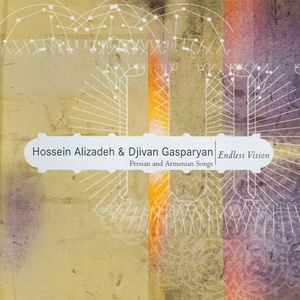
Put your hands on the remote! browse music »Endless Vision by Hossein Alizadeh & Djivan Gaspariyan
view larger image
fave it Middle East | World Traditions
7 tracks | 60 minutes
Released Dec 2006
on Hermes Records
Click
for a 30-second preview. All tracks are 192kbps high fidelity sound quality. Protected WMA $0.77 or unprotected MP3 $0.88.
listen album 30sec. shuffle buy CD review album promote album
- sample lyrics "album only" 22:19 Birds lyrics "album only" 22:19 Birds lyrics "album only" 22:19 Birds
- sample lyrics "album only" 03:07 Armenian Romances lyrics "album only" 03:07 Armenian Romances lyrics "album only" 03:07 Armenian Romances
- sample lyrics "album only" 07:40 Sari Galin lyrics "album only" 07:40 Sari Galin lyrics "album only" 07:40 Sari Galin
- sample lyrics "album only" 08:17 Call of the Birds lyrics "album only" 08:17 Call of the Birds lyrics "album only" 08:17 Call of the Birds
- sample lyrics "album only" 05:55 Mama lyrics "album only" 05:55 Mama lyrics "album only" 05:55 Mama
- sample lyrics "album only" 05:58 Shurangiz Improvisation lyrics "album only" 05:58 Shurangiz Improvisation lyrics "album only" 05:58 Shurangiz Improvisation
- sample lyrics "album only" 07:12 Tasnif Parvaneh Sho lyrics "album only" 07:12 Tasnif Parvaneh Sho lyrics "album only" 07:12 Tasnif Parvaneh Sho
This album was a 49th Annual Grammy Award Nominate: Best Traditional Music Album (Vocal or Instrumental). A program of traditional Persian and Armenian songs, featuring duduk.
Editorial review
This meeting of two musical masters in Tehran in the summer of 2003 was played out in front of an audience of 12,000. Armenian duduk (a cylindrical wooden flute that is often referred to as an Armenian oboe) maestro Djivan Gasparyan and Persian shurangiz (a new Iranian six-string lute) wizard Hossein Aliz?deh were backed on this occasion by Iran's Hamavayan Ensemble, and two other duduk players -- Armen Ghzaryan and Vazgen Markaryan (bass duduk) -- in a program of traditional Persian and Armenian songs. The first selection, "Birds," begins with shurangiz, hand drums, and spare duduk melodies, as two voices -- male and female -- begin to moan and then sing the poetry of Mahmoud Moshref Azad Tehrani, the most famous and controversial of Persian poets (Azad died in 2006). The Ensemble has made this a standard part of their repertoire for a number of years, and its embellishment by Gasparyan adds depth and dimension of the sung voices, underscoring their sad, deeply moving quality. The "Armenian Romances" are improvisations in dastgah. The dastgah: Shur is an eight-note scale which also has a group of melodies assigned to it called "gushes" which are usually made up of four or five tones. Basically, this is the designated term for improvisation in a Radif, or mode. The group plays the traditional Azerbaijan folk song "Sari Galin," ("The Yellow Bride"); the quiet dignity of the tune is sung in duet and spins itself out slowly and purposefully. "Call of the Birds," is an instrumental with the band and Gasparyan accenting the rhythmic cadences. Gasparyan's own poetry is heard on "Mama," with the other duduk players preparing the ground for him -- one playing melody, the other a drone. Gasparyan's voice is high, lonesome, half-whispered, half-sung. It's devastatingly beautiful. A shurangiz improvisation follows, and then comes the program's closer, a gorgeous song with poetry by the Islamic mystic poet Molavi. What the music amounts to is a space out of time, where the past lives eternally into the present and the present gives up its preoccupations with future. The music itself is poetic, full of space, haunting modes, and spiritual melody that is as rooted in the body as love itself is. Highly recommended. ~ Thom Jurek, All Music Guide
Bio / Background
*
"Endless Vision" 49th Annual Grammy Award Nominate: Best Traditional Music Album (Vocal and Instrumental)
........................................................................................................................
Review by Thom Jurek, All Music Guide
This meeting of two musical masters in Tehran in the summer of 2003 was played out in front of an audience of 12,000. Armenian duduk (a cylindrical wooden flute that is often referred to as an Armenian oboe) maestro Djivan Gasparyan and Persian shurangiz (a new Iranian six-string lute) wizard Hossein Alizâdeh were backed on this occasion by Iran's Hamavayan Ensemble, and two other duduk players Armen Ghzaryan and Vazgen Markaryan (bass duduk) in a program of traditional Persian and Armenian songs.
↓ more ↓
The first selection, "Birds," begins with shurangiz, hand drums, and sparse duduk melodies, as two voices male and female begin to moan and then sing the poetry of Mahmoud Moshref Azad Tehrani, the most famous and controversial of Persian poets (Azad died in 2006). The Ensemble has made this a standard part of their repertoire for a number of years, and its embellishment by Gasparyan adds depth and dimension of the sung voices, underscoring their sad, deeply moving quality. The "Armenian Romances" are improvisations in dastgah. The dastgah: Shur is an eight-note scale which also has a group of melodies assigned to it called "gushes" which are usually made up of four or five tones. Basically, this is the designated term for improvisation in a Radif, or mode. The group plays the traditional Azerbaijan folk song "Sari Galin," ("The Yellow Bride"); the quiet dignity of the tune is sung in duet and spins itself out slowly and purposefully. "Call of the Birds," is an instrumental with the band and Gasparyan accenting the rhythmic cadences.
Gasparyan's own poetry is heard on "Mama," with the other duduk players preparing the ground for him -- one playing melody, the other a drone. Gasparyan's voice is high, lonesome, half-whispered, half-sung. It's devastatingly beautiful. A shurangiz improvisation follows, and then comes the program's closer, a gorgeous song with poetry by the Islamic mystic poet Molavi. What the music amounts to is a space out of time, where the past lives eternally into the present and the present gives up its preoccupations with future.
The music itself is poetic, full of space, haunting modes, and spiritual melody that is as rooted in the body as love itself is. Highly recommended.
↑ less ↑