Top tracks
Listeners also bought
Other Bebop albums
Other Traditional Jazz Combo albums
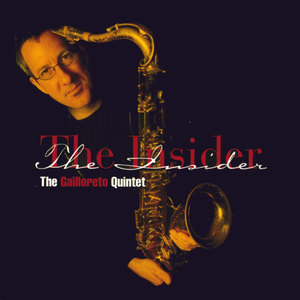
Put your hands on the remote! browse music »The Insider by Jim Gailloreto
view larger image
fave it Bebop | Traditional Jazz Combo
10 tracks | 53 minutes
Released May 2003
on Wide Sound
Click
for a 30-second preview. All tracks are 192kbps high fidelity sound quality. Protected WMA $0.77 or unprotected MP3 $0.88.
listen album 30sec. shuffle buy CD review album promote album
- sample lyrics "DOWNLOAD" 05:51 Four Brothers lyrics BUY MP3 05:51 Four Brothers lyrics "GIFT MP3" 05:51 Four Brothers
- sample lyrics "DOWNLOAD" 06:16 I Want To Be Happy lyrics BUY MP3 06:16 I Want To Be Happy lyrics "GIFT MP3" 06:16 I Want To Be Happy
- sample lyrics "DOWNLOAD" 05:20 Come Sunday lyrics BUY MP3 05:20 Come Sunday lyrics "GIFT MP3" 05:20 Come Sunday
- sample lyrics "DOWNLOAD" 04:36 Lennie's Pennies lyrics BUY MP3 04:36 Lennie's Pennies lyrics "GIFT MP3" 04:36 Lennie's Pennies
- sample lyrics "DOWNLOAD" 05:23 Mood Indigo lyrics BUY MP3 05:23 Mood Indigo lyrics "GIFT MP3" 05:23 Mood Indigo
- sample lyrics "DOWNLOAD" 06:03 Mercurial lyrics BUY MP3 06:03 Mercurial lyrics "GIFT MP3" 06:03 Mercurial
- sample lyrics "DOWNLOAD" 05:37 Andante lyrics BUY MP3 05:37 Andante lyrics "GIFT MP3" 05:37 Andante
- sample lyrics "DOWNLOAD" 04:59 The Insider lyrics BUY MP3 04:59 The Insider lyrics "GIFT MP3" 04:59 The Insider
- sample lyrics "DOWNLOAD" 04:14 Shakin Loose lyrics BUY MP3 04:14 Shakin Loose lyrics "GIFT MP3" 04:14 Shakin Loose
- sample lyrics "DOWNLOAD" 05:22 Beatrice lyrics BUY MP3 05:22 Beatrice lyrics "GIFT MP3" 05:22 Beatrice
Instrumental Jazz, Original tunes and familiar standards in modernist shades from composers such as Duke Ellington, Sam Rivers, Beethoven and Lennie Tristano. John Mc Lean (g) Larry Kohut (b) Steve Million (p ) Eric Montzka (d)
Editorial review
The Insider, the debut CD by veteran Chicago tenor saxophonist Jim Gailloreto, starts out similar in intent to Greg Osby's St. Louis Shoes, which was recorded around the same period, although the projects were quite independent of each other. For the first five selections, Gailloreto recasts veteran standards in modern settings, altering the chords, sometimes playing out of tempo and making the tunes sound quite a bit different than expected. This is particularly true of "Four Brothers," "I Want to Be Happy," and a spacy "Mood Indigo." The second half of the program has Gailloreto and his quintet exploring two of the leader's originals, a Beethoven theme, a song from pianist-organist Steve Million, and Sam Rivers' "Beatrice." Gailloreto has a strong sound of his own and interacts comfortably with the other musicians, with some fine solos taken by Million and guitarist John McLean (who sometimes sounds a bit like Bill Frisell). This continually surprising yet generally relaxed set is well worth checking out. ~ Scott Yanow, All Music Guide
Bio / Background
Strongly flavored improvisations that blend traditional and contemporary sensibilities; savvy, inventive arrangements that re-cast familiar tunes in modernist shades; new compositions that get under the skin after only a couple of hearings - all from a guy who has spent much of his professional life gently correcting people who keep misspelling his name. What have we here?
The veteran saxophonist Jim Gailloreto may be an unknown quantity to most listeners outside Chicago (where he grew up and has worked for virtually his entire adult life). But rest assured: hometown music-lovers know what they've got in Gailloreto, who has worked venues ranging from his weekly experimental session in an Evanston pub to the 2002 Chicago Jazz Festival, where his "tenor battle" with New Yorker Seamus Blake (winner of the Thelonious Monk Institute Competition) brought the crowd to its feet.
↓ more ↓Gailloreto's steadily evolving concept and handsomely polished sound have earned him praise from audiences and testimonials from his peers.
I'll add my own. From the first time I heard him onstage, more than 20 years ago, I've admired his remarkable ability to play to an audience without playing down to them. Avoiding pretense and bravado, Jim Gailloreto lets you hear him think. Instead of trying to bowl you over with tricks or carefully honed pet phrases, he invites you along on each solo: he shows you where he's been and where he's going, so that even complex improvisational gambits unfold clearly and naturally. Like the master storytellers of any idiom, from theater to painting, Gailloreto understands that communicative clarity is not the enemy of artistic integrity.
And so, on this first album under his own name, songs and solos leap out with a life of their own. Gailloreto has been playing the opening tune, the bop classic "Four Brothers," since high school, and its inclusion here nods at his brief stint with the Woody Herman Orchestra in the 1980s. But the tune has never sounded like this: its reworked melody line, doubled by Steve Million on organ, features dark harmonies and floats on a Chicago shuffle-beat, the better to enhance the "hypnotic quality of the melody" (as Gailloreto describes it). This "hypnotic" concept extends to the freewheeling solos, which swirl against a harmonic backdrop devoid of the chord progressions that originally defined the tune. Instantly recognizable, utterly transformed, "Four Brothers" becomes a viable anthem for a new generation.
Re-harmonization also plays a role in Gailloreto's version of the Ellington classic "Mood Indigo." The new chords, as serene as Ellington's, include a hint of portent; then they relax into the original harmonies (in the penultimate duet between guitarist John McLean and bassist Larry Kohut). For contrast, try "Lennie's Pennies," the little-known Lennie Tristano tune based on "Pennies From Heaven," where the melody itself provides the accompaniment for Eric Montzka's drumming. ("I felt the melody was so strong, in the sax and piano," Gailloreto says, "that the rhythm section could actually blow over it.")
In each case, techniques that might be merely clever, in others' hands, offer refreshing, personalized insights - a quality that also informs Gailloreto's own tunes, as well as the unexpected adaptation from Beethoven's Fifth Symphony ("Andante"). They add up to a debut well worth the wait, from a guy whose name bears repeating. And for the record, you spell it with two "l"s, one "t": Gailloreto.
Get it right; he did.
NEIL TESSER
Neil Tesser is a Deems Taylor Award-winning jazz journalist and host of the daily radio program "Miles Ahead" in Chicago
↑ less ↑