Top tracks
Other Weird Jazz albums
Other Free Jazz albums
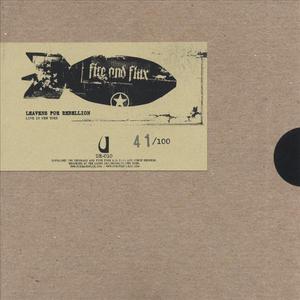
Put your hands on the remote! browse music »Leavens For Rebellion by Fire&Flux
view larger image
fave it Weird Jazz | Free Jazz
5 tracks | 49 minutes
Released Jul 2005
on Utech Records
Click
for a 30-second preview. All tracks are 192kbps high fidelity sound quality. Protected WMA $0.77 or unprotected MP3 $0.88.
listen album 30sec. shuffle buy CD review album promote album
- sample lyrics "album only" 08:13 I Think It's So We Can Look At Them Without Them Looking Back... lyrics "album only" 08:13 I Think It's So We Can Look At Them Without Them Looking Back... lyrics "album only" 08:13 I Think It's So We Can Look At Them Without Them Looking Back...
- sample lyrics "album only" 08:43 Music Is The Silence That Interrupts The Noise lyrics "album only" 08:43 Music Is The Silence That Interrupts The Noise lyrics "album only" 08:43 Music Is The Silence That Interrupts The Noise
- sample lyrics "album only" 08:41 Legitimation Crisis lyrics "album only" 08:41 Legitimation Crisis lyrics "album only" 08:41 Legitimation Crisis
- sample lyrics "album only" 16:19 Recurring Lonely lyrics "album only" 16:19 Recurring Lonely lyrics "album only" 16:19 Recurring Lonely
- sample lyrics "album only" 07:52 Unpolluted Water lyrics "album only" 07:52 Unpolluted Water lyrics "album only" 07:52 Unpolluted Water
Freejazz duo improvisations of alto saxophone, drums and percussion that traverses a sonic terrain from blistering, blowout cacophony to subtle, melodic calm... "Political-spiritual" music.
Bio / Background
FIRE&FLUX
Benjamin Kates / Alto Saxophone
Richard Gilman-Opalsky / Drums and Percussion
FIRE&FLUX is an improvising duo consisting of saxophone and drums that draws on various traditions in freejazz and improvisation, as well as on a variety of other music and genres outside of the mainstream that have inspired us. The two of us have been playing and practicing together for the past eight years.
FIRE&FLUX's improvisations are always accompanied with some text or imagery, both in performances and on record. At a performance, listeners may see a projection, an easel with imagery, or they may receive a program for the show. These measures are taken in order to anchor an otherwise extremely abstract music to particular ideas and arguments. Our improvisations, in other words, are a part of an effort to communicate particular things that we are thinking about, in addition to the experience of our sonic output.
↓ more ↓Our music is often accompanied with political reflections and critiques that address issues of social, economic and political inequalities, matters of foreign policy, and problems of political culture. This does NOT mean that we don't play pieces about love, music, happiness, and other more uplifting matters of the human spirit. We do. We try to express a broad range of feelings and thinking, to engage a diversity issues.
FIRE&FLUX generally utilizes four approaches to making music: 1) Some pieces are organized around written melodies-we play the melodies and improvise "outwards" from them, going "outside" of the melodies. 2) Some pieces are read off of a kind of "sheet music" on which tempo, volume, intensity, pauses, silences and solos are indicated, but where the actual notes and actual rhythms are wholly improvised under the guidance of the spirit or the meaning of the theme of the piece. 3) Some pieces could be called "game pieces." With these, each of us plays a predetermined role or "acts out" a predetermined relationship to/with the other player. 4) Finally, some pieces are entirely improvised, with no structural guidelines other than the meaning, the mood, and the spirit or the theme of the piece.
BENJAMIN KATES started playing saxophone in the 4th grade. He got serious in high school and started at NYU in 1996 as a music education major. But playing 2 to 4 to 6 hours a day burnt him out on the horn, so he put it down for a while and only picked up again for regular "woodshedding" when FIRE&FLUX began. Ben often plays fast and fiercely, but always with a penchant for melody, which he never abandons for long. Ben also teaches 8th grade English in Harlem, NY.
RICHARD GILMAN-OPALSKY started playing the drums somewhere between 8 and 10 years of age. One of his interests is in a method he calls "transitive resonance." With transitive resonance, the idea is to send vibrations from one part of the drum set through another part by laying a drum stick or other implement on the drums. Using this technique, Rich sometimes aims to resonate as many sounds as possible off of the drum set at one time. Other times, the idea is to generate sounds that are not normally acoustically produced with drums. "Improvisation, for me, is the most vital and living way to approach music, to engage other players with attentive listening and creative, sensible, responses. The ideals of freedom, communication, and provocation are in the forefront of my music and musical thinking."
The title of this CD, "Leavens for Rebellion", was derived from the following:
"Obviously, Anarchism, or any other social theory, making man a conscious social unit, will act as a leaven for rebellion... High strung, like a violin string, they weep and moan for life, so relentless, so cruel, so terribly inhuman. In a desperate moment the string breaks. Untuned ears hear nothing but discord. But those who feel the agonized cry understand its harmony; they hear in it the fulfillment of the most compelling moment of human nature." -Emma Goldman, 1917
NOW, CHECK OUT SOME VIDEO SHORTS OF FIRE&FLUX LIVE AT
http://www.youtube.com/profile_videos?user=fluxist
↑ less ↑